
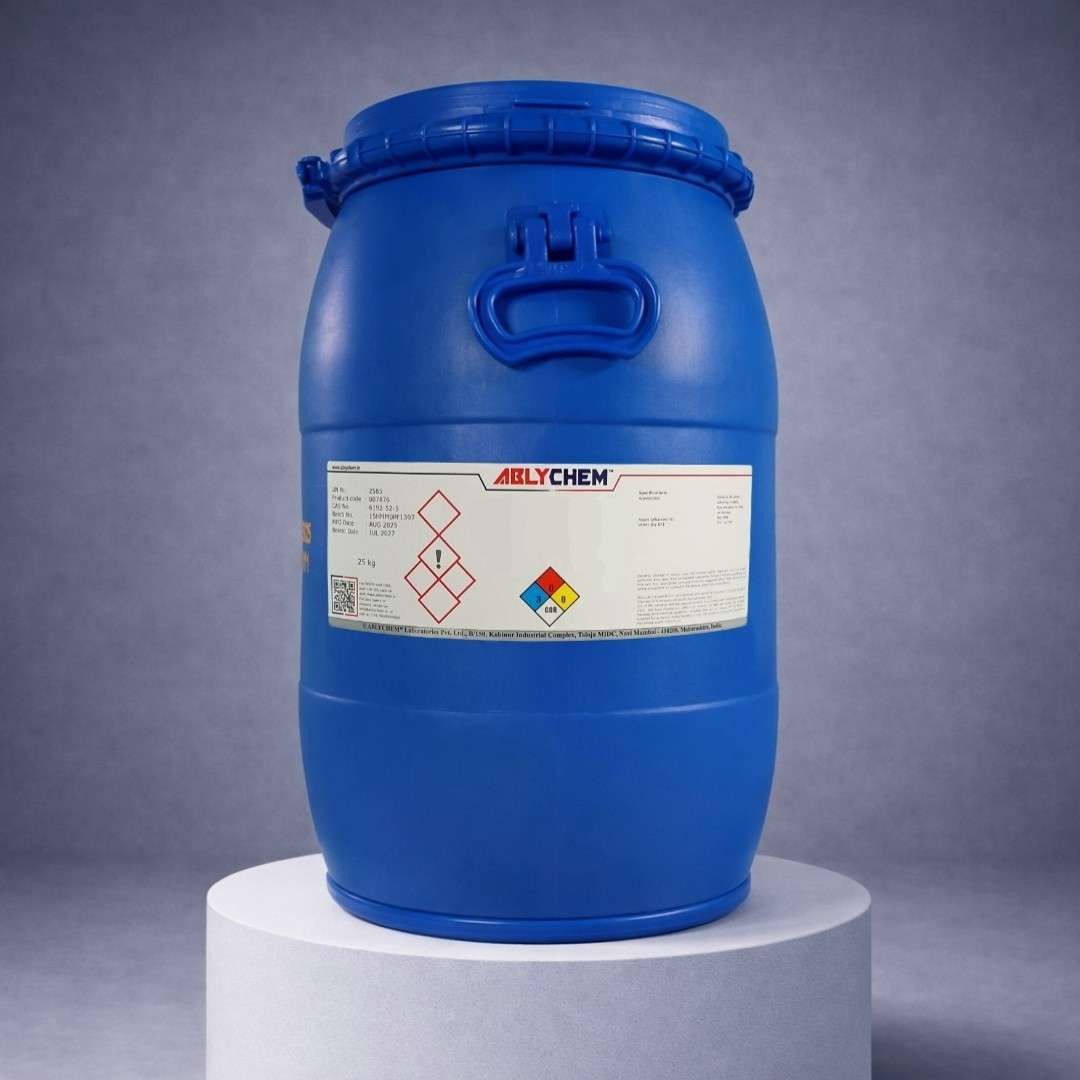
Basic information about this product
Safety and hazard classification
 GHS03
GHS03
 GHS07
GHS07
Important safety instructions and precautions
Signal Word: Warning
UN No.: 1479
IMCO Class No.: 5.1
Packing Group: II
Hazardous Statement: H272-H302-H319
Precaution Statement: P210-P220-P264-P280-P301+P312-P305+P351+P338
Detailed information about the product
Product Overview
Potassium Iodate 99% Extra Pure (CAS No. 7758-05-6) is the potassium salt of iodic acid and contains iodine in the +5 oxidation state. The iodate anion is a stable oxidising species that can be reduced through well-defined redox reactions and can generate molecular iodine from iodide under suitably acidic conditions. These properties make potassium iodate useful as an oxidant and as a controlled source of iodine equivalents in laboratory chemistry.
The Extra Pure grade is intended for general reagent preparation, preparative redox chemistry and laboratory investigations of iodine oxidation-state chemistry. The 99% assay is suitable to be used for all the laboratory activities that suits the stated specifications.
Typical Applications
Common Synonyms
Storage Conditions
Store tightly closed and dry to maintain reagent composition and prevent contamination. Keep free from reducing contaminants or other substances capable of consuming iodate, as such contamination can alter its oxidising capacity.