Basic information about this product
Safety and hazard classification
 GHS02
GHS02
 GHS05
GHS05
 GHS07
GHS07
 GHS09
GHS09
Important safety instructions and precautions
Signal Word: Danger
UN No.: 2218
IMCO Class No.: 8,3
Packing Group: II
Hazardous Statement: H226-H302+H312+H332-H314-H335-H400
Precaution Statement: P210-P273-P280-P301+P330+P331-P303+P361+P353-P304+P340-P305+P351+P338-P312
Detailed information about the product
Product Overview
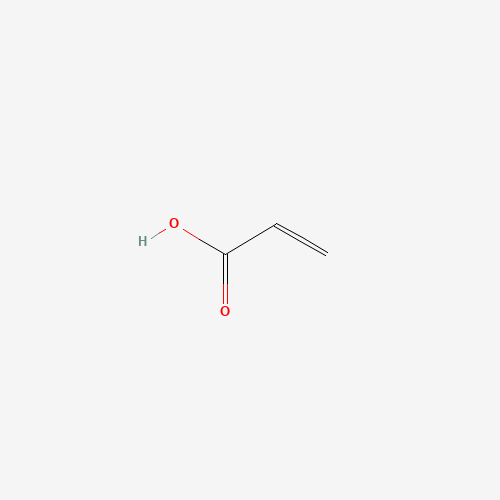
Acrylic Acid (Stabilized) 98% For Synthesis (CAS No. 79-10-7) is an α,β-unsaturated monocarboxylic acid containing a polymerisable carbon–carbon double bond conjugated with a carboxyl group. This dual functionality enables acrylic acid to react both as a vinyl compound and as a carboxylic acid, allowing it to participate in polymerisation, addition, esterification, and derivative-forming reactions. Its reactive structure makes it an important monomer and synthetic feedstock in organic and polymer chemistry.
The Synthesis grade is intended for preparative chemistry, reaction development, monomer studies, and polymer research in which acrylic acid is used as a reactant or building block. The stabilised form incorporates a polymerisation inhibitor to reduce premature polymer formation during normal handling and storage. Its 98% assay makes it suitable for routine laboratory synthesis and material-development procedures requiring consistent starting-material quality.
Typical Applications
Acrylic acid is established as a feedstock for acrylic derivatives, homopolymers, copolymers, dispersing agents, thickeners, flocculants, and superabsorbent materials.
Common Synonyms
Storage Conditions
Store in a tightly closed, chemically compatible container within the temperature range specified on the approved product label, protected from direct light and localised heating. Prevent contamination and do not alter the supplied stabilisation system or prescribed storage atmosphere. Acrylic acid should be handled and stored strictly according to the applicable Safety Data Sheet because unsuitable conditions may impair stabiliser performance and promote unwanted polymerisation.